
Anne Arundel Court Records After Arrest
Court records after a jail arrest in Anne Arundel County begin as separate records from the jail's intake file. The county detention locator can show current location, housing, bail amount, future court dates, and District or Circuit case numbers. The formal charge record is maintained through the Maryland courts. Once a person is arrested and processed through county detention, a District Court commissioner or judicial officer handles the initial appearance and release review under Maryland criminal rules. Prosecutors then review the facts and charges that move forward in court.
That distinction matters when a name search gives mixed results. The custody side answers whether the person is held at Jennifer Road Detention Center, Central Holding and Processing Center, or Ordnance Road Correctional Center. The court side answers what charge was filed, whether the charge changed, whether a hearing is set, and whether the case ended in dismissal, nolle prosequi, stet, plea, trial, or conviction. For the custody roster side, use the Anne Arundel County jail inmate records page. For booking photos and PIA requests for photos, use the Anne Arundel County jail mugshots page.
Find Anne Arundel Court Records
The main public portal for Anne Arundel County court records after an arrest is Maryland Judiciary Case Search. Maryland Courts explains that Case Search gives public access to case records from the District Court and Circuit Courts, while complete case files are handled through the clerk. Since December 7, 2021, Case Search defaults to exact-name search. Partial searches use a percent sign at the end of the first or last name. The percent sign is not placed at the start or middle of a word.
The better route is often to search by case number. The Anne Arundel County Inmate Locator may show District Court Case(s) and Circuit Court Case(s) in the details view. A full case number is more precise than a name, especially when the booked name, legal name, and court spelling differ. Dashes can be omitted in a case-number search. For traffic matters, Maryland Courts notes that leading zeroes may be omitted by entering the rightmost seven digits.
| Field Label | Type | Required | Anne Arundel Search Notes |
|---|---|---|---|
| Name | Text | Yes for name search | Exact by default; use `%` at the end for partial first or last names when spelling is uncertain. |
| Case Number | Text | Yes for case-number search | Enter the entire case number when known; dashes may be omitted. |
| Court and case filters | Dynamic fields | Varies | The current portal hides irrelevant fields, so use the visible filters that match the case type. |
| Search | Button | n/a | Submits the court query and returns public case summaries when records are available. |
Search After a Jail Arrest
A practical Anne Arundel County court records search starts with the record system most likely to have the identifier. The county detention locator is useful because it can return future court dates, bail amount, and case numbers, even though it does not show charge descriptions in the reviewed public template. The court portal is then used for the charge list and disposition. If the public portal is incomplete, request the full court file from the proper clerk.
- Search the Anne Arundel County Inmate Locator by JID or exact first and last name.
- Save the current location, bail amount, court date, and any District Court or Circuit Court case number.
- Open Maryland Judiciary Case Search inquiry and search by the full case number first.
- If no case number is available, search by exact defendant name, then try a trailing `%` wildcard for spelling variants.
- Read each charge, hearing date, case status, and disposition separately because one arrest can produce more than one count or case.
- For complete pleadings, orders, or certified copies, contact the District Court or Circuit Court clerk rather than relying only on the public summary.
Anne Arundel Charging Role
Maryland counties use State's Attorneys, not District Attorneys. The Office of the State's Attorney for Anne Arundel County prosecutes criminal cases for the State of Maryland. The official source reviewed identified Anne Colt Leitess as State's Attorney, with the main office at 8 Church Circle, Suite 200, Annapolis, MD 21401, phone 410-222-1740, and email asksao@aacounty.org. Elected offices can change, so the current office page is the source to verify before citing a name in a time-sensitive context.
The State's Attorney review is why the first charge label after an arrest may not match the final court charge. Police, commissioners, or initial charging papers may start the process. A prosecutor can proceed, amend, reduce, add, or decline charges. District Court commonly handles misdemeanors, traffic, DUIs, trespass, theft, minor controlled-dangerous-substance matters, and some felonies, and it has no jury trials. More serious matters, appeals, and jury-trial prayers move to Circuit Court.
The State's Attorney public-information page describes PIA access to SAO public records but also notes that privileged or exempt records must be withheld. Examples include internal work product and pending-trial materials. Personally identifying information may be redacted. Completed PIA forms and attachments may be emailed to asksao@aacounty.org, and fees are limited to direct search, review, and duplication charges, with the first two hours of search and preparation generally free.
The Anne Arundel County State's Attorney site is a useful source for the prosecutor's office role and contact path: the official SAO page.
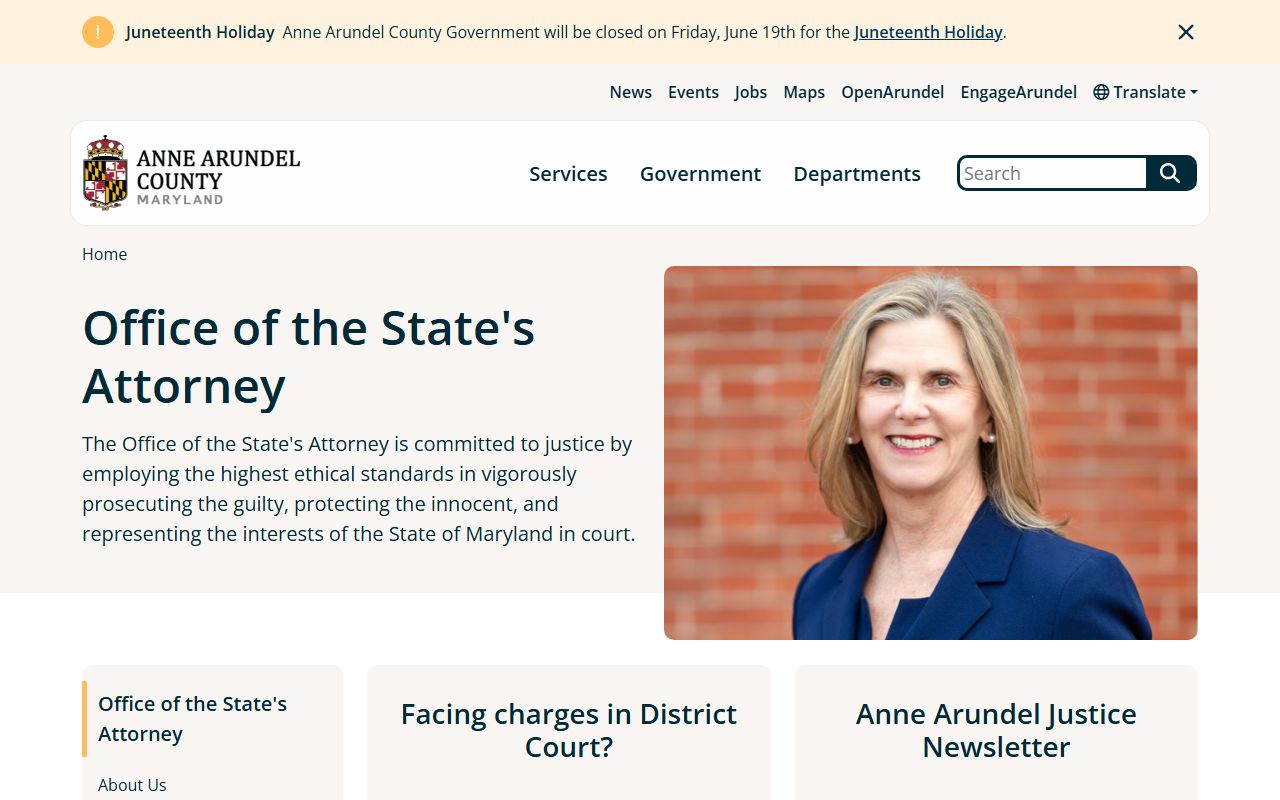
Use the SAO source for prosecutor contact and public-information routing, while using Maryland Case Search for the public court docket itself.
Anne Arundel Charging Documents
Charging documents are the bridge between an arrest and the court record. They identify the accusation that the court will track. A complaint or statement of charges may begin a lower-level case. An information is filed by a prosecutor. An indictment comes from a grand jury and is most associated with more serious felony matters. The document type does not prove guilt. It tells the court what the State is alleging at that stage.
| Document | Filed By | Common Use | What to Check |
|---|---|---|---|
| Complaint | Officer, commissioner, or prosecutor path | Initial District Court criminal matters and misdemeanor-style filings | Case number, statement of facts, court date, and any later amended charge. |
| Information | State's Attorney | Prosecutor-filed charges, including many felony paths | Whether the information replaced, added to, or refined earlier charges. |
| Indictment | Grand jury | Serious felony cases and Circuit Court prosecution | Counts, offense dates, arraignment date, and bond or hold status. |
Anne Arundel Charge Status
Charge status terms should be read count by count. One count can be dismissed while another remains pending. A nolle prosequi entry means the State declined to prosecute that charge. A stet means the case is placed on an inactive docket subject to rules and conditions. A conviction requires a guilty plea, verdict, or other adjudication that results in guilt. A booking entry or arrest alone is not a conviction.
| Status | What It Means | Why It Matters |
|---|---|---|
| Pending | The charge has not reached a final disposition. | Future hearings, bond terms, or release conditions may still control. |
| Amended or reduced | The formal charge changed after review, plea talks, or court action. | The court charge may differ from the initial arrest or booking description. |
| Dismissed or acquitted | The charge did not result in conviction. | Expungement may be possible, but eligibility depends on Maryland law and the whole case. |
| Nolle prosequi | The State declined to prosecute the charge. | The public case record may remain until expunged or otherwise restricted. |
| Stet | The case is inactive under court conditions. | It is not the same as a conviction, but it can affect expungement timing. |
Bond After Anne Arundel Arrest
The Anne Arundel County locator can display a bail amount, but the release decision comes through the Maryland pretrial and court process. The county Pretrial Services unit gathers verified social and criminal-history information, makes release recommendations at bail hearings, and monitors defendants who are released to program supervision. Maryland Rule 4-216.1 favors recognizance or unsecured bond when appropriate and requires attention to appearance, public safety, victim risk, community risk, and the least onerous conditions that will work.
Confirm bond before paying or traveling. The reviewed locator template does not show bond type, so a displayed amount may not tell whether cash, surety, ten-percent, or another condition applies. Call Detention Facilities at 410-222-7374 or confirm through the court, attorney, or licensed bail agent. Anne Arundel County has also posted a scam alert about callers pretending to be detention supervisors and asking families to pay for early release, bail, or ankle monitors.
| Bond or Hold Type | How It Works | Local Checkpoint |
|---|---|---|
| Cash bond | Money is paid directly under court rules to secure release. | Verify accepted payment method before appearing at a facility or court office. |
| Surety bond | A licensed bail agent or surety posts the bond under agreed terms. | Confirm the bond type and court case number first. |
| Personal recognizance | Release is based on promise to appear and obey conditions, not secured money. | Read all court conditions, including no-contact or supervision terms. |
| Pretrial supervision | The defendant is released under monitoring and program rules. | Follow Anne Arundel County Pretrial Services instructions exactly. |
| No-bond or detainer hold | Ordinary posting will not release the person because another order or agency hold controls. | Look for bench warrants, probation/parole holds, Circuit Court holds, federal custody, or ICE transfer issues. |
Warrants Before Anne Arundel Arrest
Warrants can explain why an arrest led to booking at the Jennifer Road complex. The Anne Arundel County Sheriff's active-warrants page requires the user to accept a disclaimer before the data loads. The research capture showed a public list for unserved Anne Arundel County warrants active for six months or longer. It does not include every unserved warrant, and a warrant can remain visible until the next weekly update even after service.
Use the Sheriff's page as an informational lead, not as a clearance tool. A "not found" result does not prove no warrant exists. Bench warrants from a recent missed court date may appear first in Maryland Case Search, with the clerk, or through counsel. For urgent issues, contact an attorney, the Sheriff's Office at 410-222-1570, or the court tied to the underlying case. A PIA request may help for disclosable warrant records, but law-enforcement and court exemptions can limit release.
Charges, Convictions, and Expungement
A charge is not a conviction. Maryland court records after a jail arrest can show both accusations and outcomes, so the final disposition is the key field. Maryland Criminal Procedure §10-105 governs expungement for qualifying police and court records after specified dispositions, and §10-110 covers certain convictions. Expungement is not automatic in every case, and one nonqualifying count can affect the rest of a case.
| Point | Charge | Conviction |
|---|---|---|
| Meaning | An accusation filed in court. | A guilty plea, verdict, or adjudicated outcome. |
| Proof stage | Based on probable cause and charging review. | Based on plea or proof beyond a reasonable doubt. |
| Public record effect | May appear in Case Search unless restricted. | May appear as the disposition and can affect sentence, probation, or custody. |
Sealed and expunged records are also different. Sealing or shielding limits public view. Expungement removes qualifying police and court records from public access under Maryland's expungement process. A court record may be unavailable because of juvenile confidentiality, a court order, a rule, or an expungement, not because no arrest occurred.
| Point | Sealed or Shielded | Expunged |
|---|---|---|
| Public visibility | Hidden from most public searches. | Removed from public police and court record access when granted. |
| Access by agencies | Some official access may remain under law. | Access is much more limited, but depends on the order and record type. |
| Common trigger | Court rule, shielding law, juvenile rule, or protective order. | Eligible dismissal, acquittal, nolle prosequi, stet after waiting period, or qualifying conviction path. |
Anne Arundel Record Limits
Maryland's Public Information Act starts with the rule that public records are open unless a law permits or requires denial. General Provisions §4-201 states the baseline inspection right. §4-203 requires a prompt grant or denial and generally no later than 30 days. §4-206 allows reasonable fees, with the first two hours of search and preparation generally free.
Public access is broad, but not absolute. General Provisions §4-351 allows withholding of law-enforcement, correctional, prosecution, investigatory, security, and some misconduct records when release would cause listed harms. Court rules, juvenile confidentiality, medical privacy, pending-case concerns, and safety risks can also limit access. Formal background checks for employment, housing, credit, insurance, or similar decisions must use lawful FCRA channels rather than casual court or jail lookups.
Important: Court and jail records can be incomplete or restricted; verify any Anne Arundel County arrest case with the court, clerk, detention facility, or prosecutor that created the record.